
Architecture
Overview
Dew Finance is built on a few core components that together enable a chain-abstracted, verifiable vault framework:
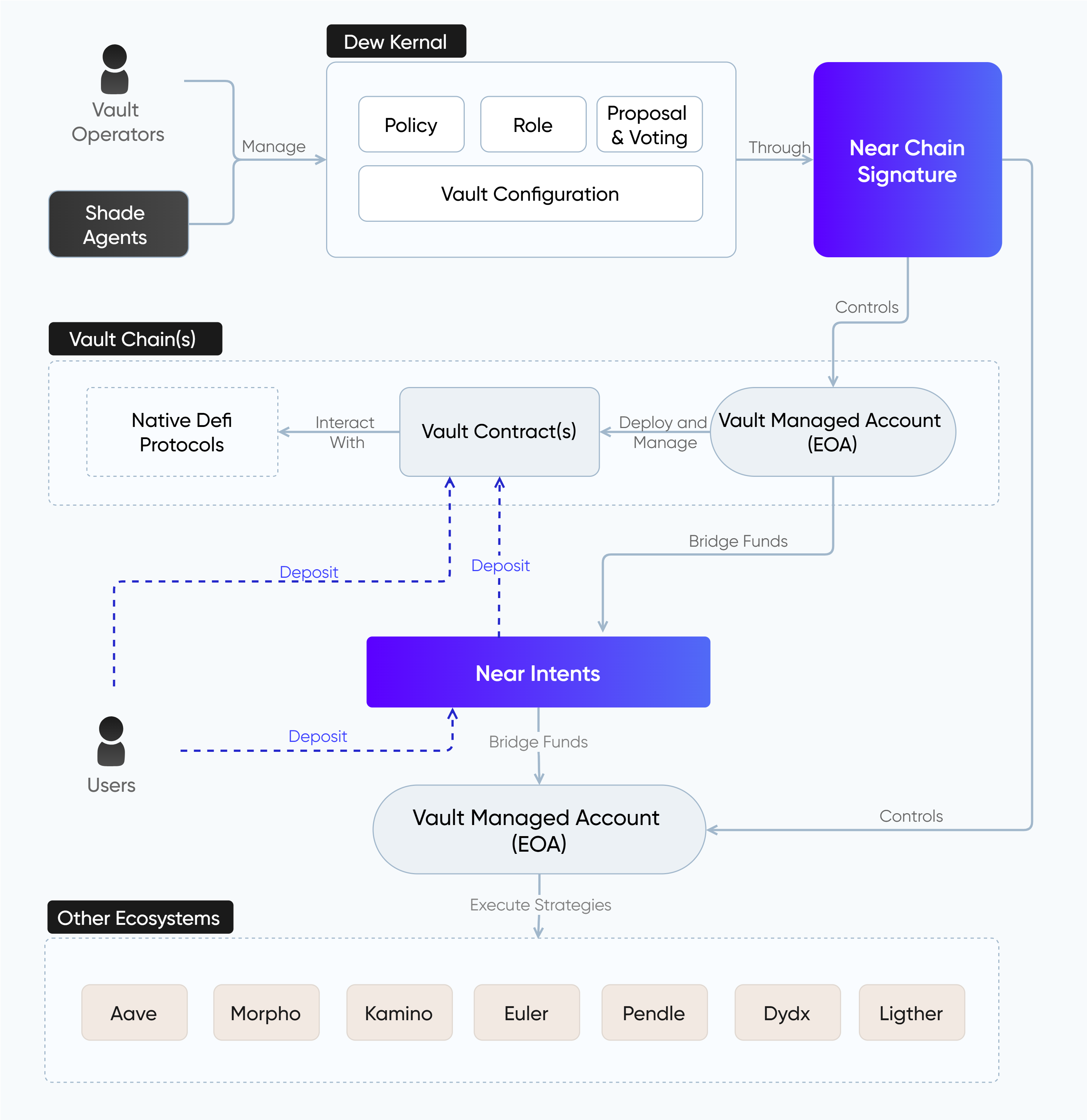
Components
Dew Kernel
The Dew Kernel is the core engine of the protocol. It is more than just an accounting layer — it defines how strategies are configured, executed, and governed.
- Vault Configuration – controls parameters such as deposit limits, fee structures, and strategy caps.
- Permission Management – enforces granular roles with native multisig to ensure resilient governance.
- Strategy Execution – defines which positions can be opened/unwound and how funds are allocated across chains.
- Proposal & Voting – enables decentralized decision-making for upgrades, strategy approvals, and policy changes.
- Settlement – manages cross-chain deposits and withdrawals, maintaining a consistent vault share supply across ecosystems.
- Other Features – integrates fee collection, referral systems, and risk management into the vault’s operations.
The Dew Kernel ensures every strategy action — whether run on-chain or off-chain — is executed within a controlled policy environment and reconciled to a single canonical state.
Vaults
Vaults are the economic containers of Dew Finance, responsible for managing deposits, share minting, and redemptions. Each vault connects strategy logic to user capital under the governance of the Dew Kernel.
- Share Minting & Redemption – vaults issue and burn standardized vault shares that track ownership across chains.
- NEAR-Deployed Vaults – can accept deposits and redemptions from most chains directly via NEAR Intents, making them inherently multi-chain accessible.
- Native-Chain Vaults – fully comply with local standards (e.g., ERC-4626 on Ethereum) and can leverage the chain’s native infrastructure (DEXs, lending markets, bridges).
- Strategy-Agnostic – vaults remain lightweight; the Dew Kernel enforces configuration, permissions, and policy logic.
This separation makes vaults highly composable: they can be natively integrated into ecosystems while still participating in Dew’s global, chain-abstracted framework.
Dew Abstract Account
The account abstraction layer that connects multiple ecosystems into Near-Deployed Vaults.
- A smart contract account that verifies signatures from different chains (EVM, Solana, TON).
- Allows external accounts from other chains to authenticate and interact directly with Near-Deployed Vaults or Dew Kernel.
- Makes cross-chain participation seamless without requiring users to create new account or use a new wallet.
Near Intents
NEAR Intents provides a universal way to receive funds from different chains and aggregate cross-chain liquidity.
- A user depositing USDC on Ethereum, USDT on Solana, or any supported assets from supported chains.
- They receive a wrapped tokens which will be routed into the Settlement Module of the Dew Vault.
- Gas is abstracted away — users don’t need ETH, SOL, or NEAR for execution.
This layer ensures deposits/withdrawals are chain-agnostic and enables developers/strategists to onboard users without cross-chain friction.
NEAR Chain Signature MPC Network
The MPC network is the execution layer for strategies.
- Controls vault accounts across external chains (BTC, ETH, Solana, and others).
- Executes wind/unwind positions via standard chain transactions.
- Makes strategy execution as flexible as a normal wallet transaction, meaning:
- Any DeFi protocol can be accessed without custom adapters.
- Off-chain signals or TEE-based logic can trigger on-chain actions.
- Every action is signed, verifiable, and auditable against the Dew Vault’s canonical state.
This is the component that removes the biggest limitation of other vault systems — no more rigid integrations or siloed strategies.
NEAR Shade Agent
A verifiable agent layer that enhances strategy operations and accounting:
- Shade Agents runs inside secure TEEs, verified on-chain, and managed through NEAR’s decentralized key infrastructure
- Enable verifiable, automated accounting and management functions — for example, reconciling off-chain signals, enforcing risk parameters, or triggering strategy adjustments with on-chain auditability.
- Make off-chain strategies transparent and verifiable. Positions in CEX or private credit deals can now be verified on-chain through fully transparent and verifiable agent code.